 Listicle
5 Best Somatic Exercises for At-Home Use
Last Updated: November 24, 2026
Quick Summary
Somatic exercises are gentle movements and breathing practices that help you notice what your body feels and calm your nervous system. Most can be done at home in a few minutes, usually sitting or lying down, with no studio, equipment or teacher needed.
- Match the exercise to how you feel: activated, numb, restless, or overwhelmed.
- Try the butterfly hug for about one minute with slow alternating taps.
- Use three-part breathing for 3 to 5 minutes to settle anxious moments.
- Stop if you feel pain, dizziness, nausea, or sharp discomfort.
- Practice a simple five-minute routine once a day, or just steps 1 and 4 if that's too much.
Table of Contents
- Which Somatic Exercises Can You Do at Home?
- 1. Butterfly Hug for Calming Your Nervous System
- 2. Spinal Wave for Releasing Tension in the Back
- 3. Orienting and 3-2-1 Sensory Grounding
- 4. Three-Part Breathing to Settle Anxious Moments
- 5. Gentle Knee Hugs and Rocking for Beginners
- A Five-Minute Routine and When to Pause
- Start Your Home Practice This Week
- Frequently Asked Questions
Somatic exercises are simple, gentle movements and breathing practices that help you notice what your body is feeling and calm your nervous system. You don't need a studio, equipment or a teacher to start. The five exercises below can be done at home in a few minutes each, most of them while sitting or lying down.
Before you start, one caution. These exercises are general self-care, not treatment. If a movement causes pain, dizziness or sharp discomfort, stop. If you have an injury, a medical condition or a history of trauma, check with your doctor or a licensed therapist first.
Which Somatic Exercises Can You Do at Home?
The best exercise for home is the one that fits your body, your space, and how you feel right now. Most of the practices below need only a chair, a wall, or a patch of floor. They focus on how you feel while you move, not on how far you can stretch.
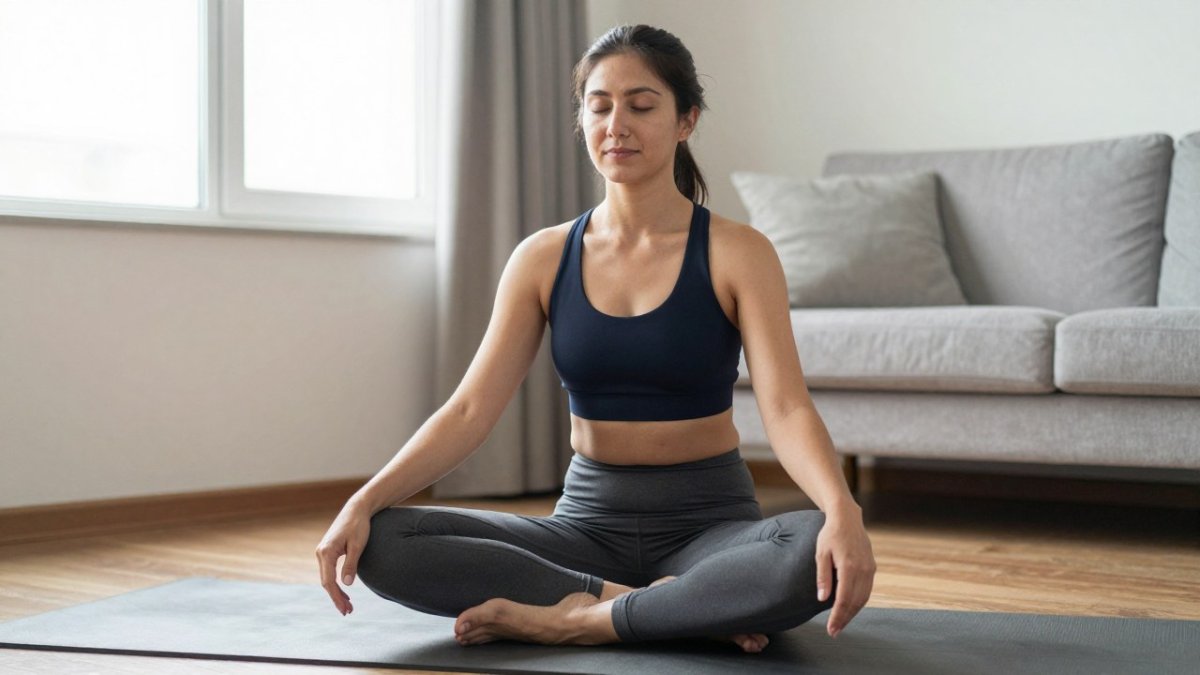
Start by checking in with your current state. A simple way is to ask: am I activated, numb, restless, or overwhelmed?
- Activated (heart racing, jaw tight, thoughts jumping): start with the butterfly hug or three-part breathing. Both give your body a steady rhythm to borrow.
- Numb or checked out: try orienting and 3-2-1 grounding first. Slow head turns and naming what you see bring you back into the room without demanding much.
- Restless (can't sit still, legs bouncing): the spinal wave or seated rocking gives that energy somewhere to go.
- Overwhelmed (teary, frozen, can't think): keep it very small. Rest your hands on your thighs, feel the chair under you, and take one slow breath. Skip anything that asks you to close your eyes or lie down if that feels unsafe.
Now match the exercise to your mobility and space. Every practice in this guide has a seated version, and most have a lying-down version. If getting to the floor is hard, do the butterfly hug, spinal wave, grounding, and breathing from a chair.
A note on lying down: some people feel more vulnerable on their back. If that's you, sit up. There is no bonus for doing it the harder way.
Watch out: if any position makes you feel dizzy, short of breath, or panicky, change positions or stop. Discomfort is information, not a test to push through.
Each practice suits a different state, so match the exercise to how you feel right now.
| Exercise | Best for | Key difference |
|---|---|---|
| Butterfly hug | Feeling activated | Slow alternating taps give a steady rhythm |
| Spinal wave | Restlessness | Small, smooth movement through the spine |
| Orienting and 3-2-1 grounding | Numbness or checking out | Uses your senses to bring you back to the room |
| Three-part breathing | Anxious moments | Fills belly, ribs, then chest in turn |
| Knee hugs and rocking | Beginners | Low effort, easy to adjust for comfort |
1. Butterfly Hug for Calming Your Nervous System
The butterfly hug is one of the simplest ways to settle your nervous system. You cross your arms over your chest, place your hands on your upper arms, and tap slowly, one side and then the other, like a butterfly's wings.
How to do it:
- Sit comfortably with your feet on the floor.
- Cross your arms over your chest so each hand rests on the opposite shoulder or upper arm.
- Close your eyes if that feels safe, or soften your gaze.
- Tap gently with alternating hands, slowly, for about one minute.
- Pause, notice your breathing, and see whether anything has eased.
The tapping gives your body a steady, rhythmic input. Some people find that it helps them slow their breathing and feel more grounded. Keep the touch light. If it feels too stimulating, try resting your hands still and just noticing the warmth of your arms.
2. Spinal Wave for Releasing Tension in the Back
The spinal wave is a gentle, flowing movement that moves through your spine one vertebra at a time. Many people hold tension in the lower back and shoulders after long hours at a desk, and this movement invites those areas to loosen.
How to do it:
- Sit on the edge of a chair with your feet flat and your knees apart.
- Inhale and slowly lift your chest, letting your lower back arch gently.
- Exhale and round your spine, tucking your chin and rounding your upper back.
- Keep the motion small and smooth, like a wave passing through your body.
- Repeat for 8 to 10 slow waves, breathing with each movement.
Move only as far as is comfortable. The goal is smooth motion, not depth. If you have a back condition, keep the range very small or skip this one.
3. Orienting and 3-2-1 Sensory Grounding
When your thoughts spiral, grounding brings your attention back to the present. Orienting means turning your head slowly to notice your surroundings. The 3-2-1 exercise uses your senses to anchor you in the room.
How to do it:
- Sit or stand where you feel steady.
- Slowly turn your head to the left, then the right, noticing what you see without judging it.
- Name 3 things you can see, 2 things you can hear, and 1 thing you can feel, such as your feet on the floor or the chair under you.
- Take one slow breath and notice how the room feels now.
This practice works well during a stressful moment at work or before a difficult conversation. It doesn't require quiet. You can do it anywhere you have a few seconds.
4. Three-Part Breathing to Settle Anxious Moments
Breathing is the most accessible somatic tool you have. Three-part breathing, also called diaphragmatic breathing, fills the belly, the ribs and the chest in turn. If you want more structured breathwork than a few self-guided breaths, you can book a guided breathwork session. It encourages a slower, fuller breath, which many people find calming.
How to do it:
- Sit comfortably and place one hand on your belly and one on your ribs.
- Inhale slowly through your nose and let your belly rise first.
- Let the breath move up into your ribs, then your upper chest.
- Exhale slowly, letting your chest, ribs and belly fall in that order.
- Repeat for 3 to 5 minutes.
If you feel lightheaded, slow down or stop and return to your normal breathing. Breathe through your nose where possible, and never force a breath.
5. Gentle Knee Hugs and Rocking for Beginners
Knee hugs and rocking are a good starting point if you're new to somatic work or feel unsure about movement. Both are low-effort, supportive and easy to adjust for your comfort level.
How to do it:
- Lie on your back on a mat or bed, or sit in a chair if lying down is uncomfortable.
- Bring both knees toward your chest and hold them with your arms.
- Rock gently from side to side for about a minute, like a slow sway.
- Let your breath follow the movement, and release when you're ready.
Rocking can bring a sense of comfort for some people. If lying down or bending the knees doesn't suit your body, rock gently while seated with your hands on your thighs.
A Five-Minute Routine and When to Pause
If you want a simple structure, try this short sequence once a day. Set a timer so you're not watching the clock.
- Butterfly hug, 1 minute
- Spinal wave, 1 minute
- Orienting and 3-2-1 grounding, 1 minute
- Three-part breathing, 1 to 2 minutes
- Knee hugs and rocking, 1 minute
Do it seated if that's easier. You can run the whole thing in a chair except the knee hugs, and those have a seated version too. If five minutes feels like a lot, do steps 1 and 4 only. Two minutes most days beats one long session you dread.
When to pause or stop
Somatic exercises are general self-care, not treatment. A few stop signals are worth knowing before you start:
- Pain, dizziness, nausea, or sharp discomfort, stop the movement and return to normal breathing.
- Feeling flooded (racing heart, shallow breath, urge to flee), open your eyes, look around the room, put your feet flat on the floor, and name three things you see. Don't push through.
- Feeling numb or shut down, this can happen too. Try gentle movement in your hands and feet, or stand up and feel your weight. If it persists, take a break.
- Strong emotions that linger, crying or feeling raw during a practice can happen and isn't a sign you're doing it wrong. If it doesn't settle within a few minutes, or if you have a history of trauma, reach out to a licensed mental health professional.
What to expect
Responses vary. Some people notice their shoulders drop or their breath slows within a minute. Others feel nothing the first few times, or feel more activated before they feel calmer. That's normal. Instead of scoring yourself, notice three things: comfort (does this feel okay in my body?), tension (where am I holding?), and attention (where did my mind go?). A simple note on your phone after each session, one line, is enough to see patterns over a week or two. If you want a hands-on session to deepen that calm, you can explore a gentle facial and head-and-neck massage.
One more distinction worth making: these are general somatic exercises you can do on your own. Somatic therapy is different, it's guided by a trained clinician and tailored to your history, often for trauma or chronic pain. Self-guided practice can support that work, but it doesn't replace it. If you find that home practice stirs up more than it settles, that's a good reason to talk to a professional rather than push harder alone.
Start Your Home Practice This Week
Pick one exercise from this list and practice it for three days. Once you've tried these at home, you might enjoy a professionally guided sound healing session for a deeper sense of calm. Notice what changes in your breathing, your shoulders and your focus. Then add a second. Consistency matters more than length, so a few quiet minutes most days will do more than one long session you dread.
If you'd like guided support once you've built the habit, Visit https://www.bodyalchemysedona.com to learn more about current services and booking.
Frequently Asked Questions
What are the most effective somatic exercises?
The most useful somatic exercises are the simple ones you will actually repeat. Gentle movements such as the butterfly hug and spinal wave, along with breathing and grounding practices like three-part breathing and 3-2-1 sensory awareness, cover most needs. Start with one or two, notice how your body responds over a week or two, and build from there. Effectiveness shows up as steadier breathing, less muscle tension and a calmer baseline, not as an instant fix.
How often should I practice somatic exercises?
Many people start with five to ten minutes once or twice a day, which is enough to build a habit without overdoing it. Short, regular sessions usually work better than one long session a week. If a movement feels uncomfortable or you feel more agitated afterward, reduce the length or the intensity. Consistency matters more than duration, so pick a time you can keep, such as after waking up or before bed.
Can somatic exercises help with stress or anxiety?
Somatic exercises can help you notice tension and steady your breathing during stressful moments, which many people find calming. They are a self-care practice, not a replacement for medical or mental health treatment. If anxiety is persistent, interferes with daily life, or includes thoughts of self-harm, reach out to a licensed therapist or your doctor. Pause any exercise that causes pain, dizziness or distress.
Can I do somatic therapy on my own?
You can practice somatic exercises on your own, and many of them are gentle enough for home use. Somatic therapy, however, is a clinical approach delivered by a trained practitioner who tailors it to your history and needs. Self-guided exercises work well for everyday regulation and stress relief. If you have trauma, chronic pain or a condition that flares with movement, a clinician-guided session is the safer route.