 ultimate-guide
Benefits of Sound Healing for Stress Relief
Table of Contents
- How Sound Healing Calms the Stress Response
- What to Expect During a Sound Bath
- How Long Is a Sound Bath Session?
- Sound Healing for Nervous System Regulation
- The Science Behind Sound Therapy and Stress
- Safety, Contraindications, and Who Should Be Cautious
- At-Home vs. Professional Sessions: Which Fits Your Stress Relief?
- Conclusion
- Frequently Asked Questions
Last Updated: September 29, 2026
How Sound Healing Calms the Stress Response
[Sound healing](/sedona-sound-healing) uses intentional sound, singing bowls, gongs, voice, to guide the body out of stress and into deep rest. At Body Alchemy Sedona, we see it session after session: shoulders drop, breathing slows. The benefits of sound healing for stress start with the nervous system, not the mind.
The Parasympathetic Shift
The parasympathetic nervous system governs rest, digestion, and recovery. Loud, unpredictable noise keeps the body on alert; steady, low-frequency sound does the opposite. During a sound bath, slow vibrations and long decay times give the brain a predictable signal to settle around, what Harvard physician Herbert Benson called the "relaxation response." In practice: lower heart rate, slower breath, less muscular tension.
What the Research Says
Clinical research on sound therapy is still developing, and honest practitioners say so. Studies on vibroacoustic therapy, which applies low-frequency sound directly to the body, have explored effects on pain, anxiety, and mood, but sample sizes are often small. The National Center for Complementary and Integrative Health overview of sound and music therapies notes that while music and sound-based approaches show promise for stress reduction, more rigorous trials are needed.
What to Expect During a Sound Bath
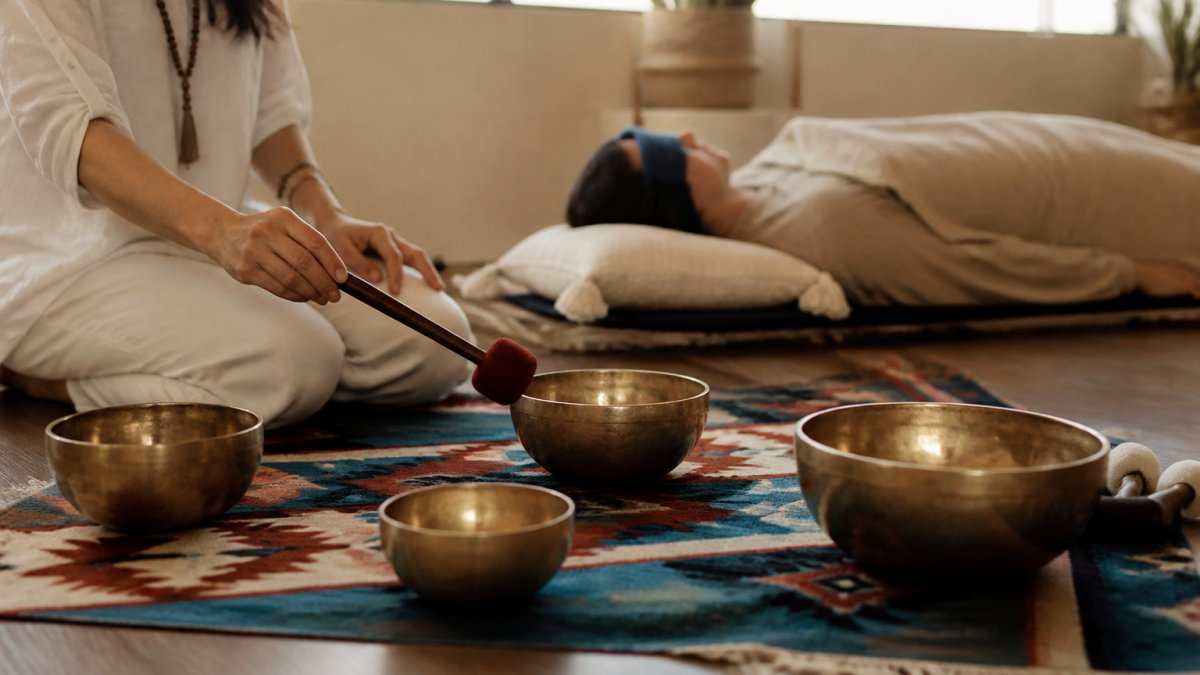
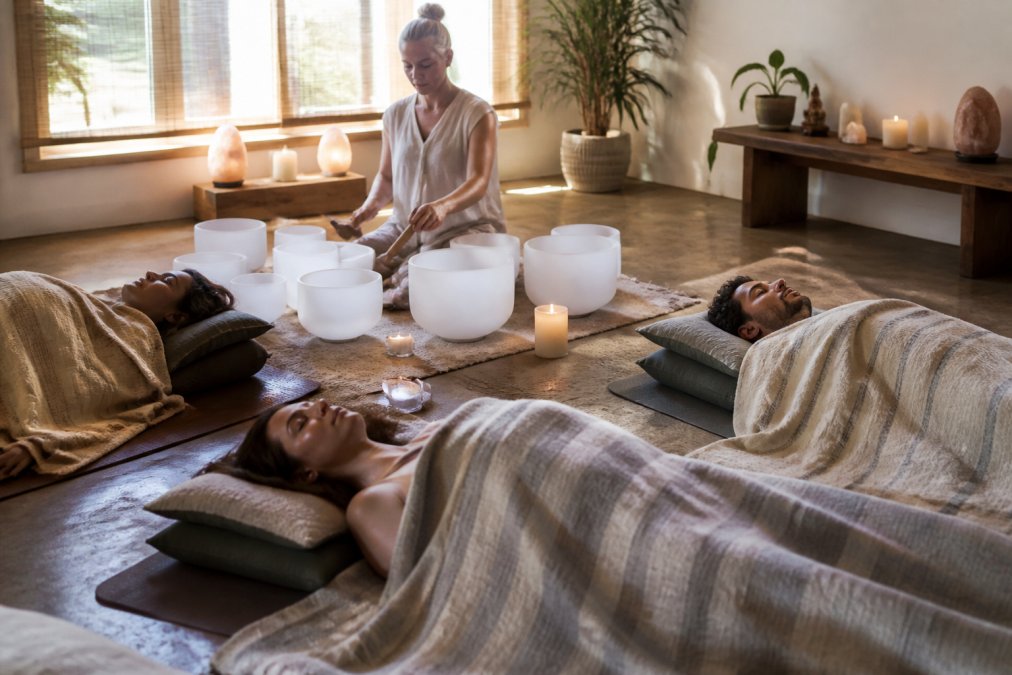
A sound bath is a guided listening experience, usually done lying down, in which a practitioner plays crystal or Tibetan singing bowls, gongs, chimes, and occasionally voice. You stay clothed, often under a blanket, and simply listen.
From Arrival to Integration
Sessions typically open with a few minutes of grounding breathwork, then move into the sound. A practitioner may walk slowly around the room, playing bowls near different parts of the body. Some people feel warmth, tingling, or emotional release; others just get sleepy. Both are normal. Afterward, most studios allow a few minutes of silence so the nervous system can integrate before you re-enter your day.
How Long Is a Sound Bath Session?
A typical sound bath runs 30 to 60 minutes, with 45 minutes most common. Group sessions often stretch to 60 or 75 minutes; private sessions can be shorter and more targeted. If you are new, start with 30 to 45 minutes. Longer is not automatically better, the goal is a nervous system that has actually downshifted, not an endurance test.
| Session Type | Typical Length | Best For |
|---|---|---|
| Private one-on-one | 30-45 minutes | First-timers, targeted stress relief |
| Group sound bath | 45-60 minutes | Community relaxation, retreats |
| Extended immersion | 60-90 minutes | Deep rest, experienced practitioners |
Sound Healing for Nervous System Regulation
Sound healing for nervous system regulation works by giving the body a consistent, low-demand auditory environment. The autonomic nervous system toggles between sympathetic (alert) and parasympathetic (rest) states; chronic stress keeps it stuck in sympathetic mode, which is why so many people feel wired even when exhausted. Rhythmic sound gives the system something steady to track, and the body follows.
The Science Behind Sound Therapy and Stress
The science behind sound therapy and stress centers on how the brain and body process rhythm, frequency, and vibration. Sound is mechanical energy: a bowl or gong pushes air into waves, the auditory system converts them into signals the brain interprets. That vibration also reaches the body through skin, muscle, and bone, which is why a low gong tone can be felt in the chest before it is consciously "heard." None of this is mystical, it is physiology, and understanding the pathway helps you choose the right session.
Brainwave Entrainment and Auditory Stimulation
Brainwave entrainment is the tendency of cortical activity to synchronize with a rhythmic external stimulus. When you hear a steady pulse, a drum, a bowl struck on a slow cycle, a binaural beat, neurons begin firing in step with that rhythm. Slow, predictable sound encourages slower, higher-amplitude patterns tied to drowsiness and deep relaxation; fast, irregular sound does the opposite. Auditory stimulation through singing bowls, gongs, chimes, and binaural beats gives the brain a consistent pattern to lock onto, one reason a sound bath feels different from sitting in silence with a racing mind.
What Is Actually Being Measured
Researchers studying sound and music interventions track concrete signals rather than vague "calm":
- Heart rate and heart rate variability (HRV). HRV reflects the balance between sympathetic and parasympathetic drive; slow, rhythmic sound is associated with higher HRV.
- Respiratory rate and depth. Breathing slows and deepens when the auditory environment is steady, feeding back into the parasympathetic system.
- Skin conductance and cortisol. Electrodermal activity and salivary cortisol are proxies for arousal and stress load; several small trials report reductions, though results vary.
- EEG frequency bands. Electroencephalography can show shifts toward slower bands during guided relaxation, the closest direct evidence for entrainment.
- Self-reported stress and mood scales. Standardized questionnaires are the most common outcome measure, and the easiest to bias.
Vibroacoustic Therapy: Sound You Feel
Vibroacoustic therapy applies low-frequency sound, roughly 30 to 120 Hz, directly to the body through speakers embedded in a mat, chair, or bed. Because the vibration bypasses the ear and travels through tissue, it is studied separately from listening-based sound baths. Research has explored it for pain, anxiety, muscle tone, and mood, and it is used in some clinical and rehabilitation settings.
Why Repetition Beats One Big Session
A common mistake is expecting a single sound bath to permanently rewire a stressed nervous system. The effect builds with repetition, like any nervous system training. Each session is a rehearsal in downshifting; over weeks, that rehearsal becomes easier to access. Hence the recommendation for a regular rhythm rather than occasional intense experiences, and why sound healing works best as a complement to, not a replacement for, medical care. (Source: American Psychological Association's resources on stress management)
Safety, Contraindications, and Who Should Be Cautious
Sound healing is generally well tolerated, but not appropriate for everyone. People with epilepsy, a history of seizures, or certain psychiatric conditions should consult a physician first, since strong rhythmic sound can, in rare cases, trigger symptoms. Anyone pregnant, with a pacemaker or implanted device, or recovering from recent surgery should check with their doctor.
At-Home vs. Professional Sessions: Which Fits Your Stress Relief?
Most articles on sound healing stop at "try a sound bath." The more useful question is how often, with what tools, and whether you need a practitioner. At-home practice is convenient and inexpensive; professional sessions offer calibrated instruments, a trained practitioner, and a space designed for rest. The right answer depends on how chronic your stress is and how much structure you need.
At-Home Tools and What They Cost
You do not need a studio to get a nervous system benefit. A basic home setup costs well under a single private session:
- A single singing bowl and mallet. Entry-level Tibetan or crystal bowls run about $30 to $100. One bowl and a slow, steady strike pattern is enough for a 10-minute wind-down.
- Guided audio and apps. Streaming and meditation apps carry sound bath, binaural beat, and singing bowl tracks, typically free with ads or a few dollars to roughly $15 per month ad-free.
- Binaural beats. These require stereo headphones and work best at low volume. Cheapest entry point, easiest to overdo, start short.
- A vibrating mat or cushion. Consumer vibroacoustic mats run from a few hundred dollars upward, which only makes sense if you already know you respond well to felt vibration.
- Your own voice. Humming and toning are free, and the vibration is felt directly in the chest and throat. A few minutes of slow humming is a legitimate practice, not a consolation prize.
Professional Sessions and What You Are Paying For
A practitioner-led session buys three things you cannot easily replicate at home: calibrated instruments played by someone who can read the room, a space engineered for rest, and accountability. Group sound baths are the most affordable professional option; private sessions cost more but let the practitioner adjust instruments, volume, and pacing to your body. If you have tinnitus, sound sensitivity, or a specific injury, that tailoring matters more than the instrument itself.
How Often Should You Practice for Sustained Stress Reduction?
This is the question most guides skip, and it determines whether sound healing actually changes your baseline. A reasonable framework:
- Daily, 5 to 15 minutes. A short home practice, one bowl, a guided track, or humming, gives the nervous system a regular rehearsal in downshifting. Consistency matters more than length.
- Weekly, 30 to 60 minutes. A weekly group sound bath or longer home session is a common rhythm for ongoing, moderate stress.
- Biweekly to monthly, 45 to 75 minutes. For deeper nervous system work or recovery from a high-stress period, a professional session every two to four weeks gives a longer, more supported reset.
- As needed. Occasional sessions around acute stressors, a difficult week, a big presentation, a loss, are legitimate, but will not build the same baseline shift as a regular rhythm.
A Simple Decision Rule
- Choose at-home if: you want a daily wind-down ritual, you are budget-conscious, you are testing whether sound resonates with you, or you want to build a habit before investing in sessions.
- Choose professional if: you are managing chronic stress, you want guidance and calibrated instruments, you need a session tailored to a specific concern, or home practice has not helped you settle.
- Choose both if: you want the daily rehearsal and the periodic deeper reset, the combination most practitioners recommend for sustained stress reduction.
Conclusion
Stress does not resolve through willpower alone; it resolves when the nervous system is given what it needs to shift. Sound healing offers one of the gentlest paths into that shift, and pairing it with massage, breathwork, or yoga deepens the effect. Body Alchemy Sedona brings these together in a therapist-led setting, in studio or at your location, with sessions customized to your body and goals.
Frequently Asked Questions
How often should you do sound healing for stress management?
There is no single schedule that works for everyone. Many people start with one session per week for three to four weeks to gauge how their body responds, then adjust to biweekly or monthly as needed. For ongoing stress, a regular rhythm helps sustain the relaxation response. If you are new to sound healing, try a single session first and notice how you feel in the days after. Some people find that one session provides lasting calm, while others prefer more frequent support. Always listen to your body and consult a qualified practitioner if you have specific health concerns.
What are the potential disadvantages or contraindications of sound therapy?
Sound healing is generally considered safe, but certain conditions warrant caution. If you are pregnant, have epilepsy, a history of seizures, a recent concussion, or a metal implant, check with your doctor before attending. Some people may feel emotionally raw or physically tired after a session, and loud gongs or bowls can be overwhelming for those with sound sensitivity. There is also a risk of falling asleep during a session, which is fine but may reduce your awareness of the experience. Always inform your practitioner of any health issues so they can tailor the session or advise against it.
Can sound baths specifically help with symptoms of anxiety?
Many people report reduced anxiety after sound baths, and some small studies suggest that sound meditation can lower tension and improve mood. The rhythmic tones may activate the parasympathetic nervous system, which counters the fight-or-flight response. However, sound baths are not a replacement for professional mental health treatment. If you experience severe anxiety, use sound healing as a complementary practice alongside therapy or medication. Start with a short session and see how you feel. A qualified practitioner can help you set an intention and create a safe environment.
What happens to the body during a sound healing session?
During a sound bath, your body often shifts into a relaxed state. Heart rate and blood pressure may decrease, breathing slows, and muscle tension releases. Brainwave activity can move toward alpha and theta states, which are associated with deep relaxation and meditation. Some people feel tingling, warmth, or emotional release. Cortisol levels may drop, and mood-regulating chemicals like serotonin and dopamine can be affected. These physiological effects are part of the relaxation response. Everyone's experience is different, so approach your first session with an open mind and no expectations.