 how-to
Is Energy Work Effective for Chronic Pain? A Practical Guide
Last Updated: October 29, 2026
Quick Summary
Energy work may help some people feel calmer and report less pain in the short term, but research on chronic pain is still limited. Studies are often small, and no well-designed trial has proven a measurable life force. Keep your medical care in place and treat energy work as a complement you track carefully.
- Many people report feeling calmer and more relaxed after energy work sessions.
- Research on energy healing for chronic pain is small and often lacks strong controls.
- Some trials show short-term drops in pain or stress scores, while others match placebo.
- Keep seeing your doctor, especially if pain worsens or you notice numbness or weakness.
- Rate your pain 0 to 10 before each session and track it across two or three visits.
Table of Contents
- What Energy Work Means and Why People Try It for Pain
- What Reiki for Chronic Pain Looks Like in a Session
- What the Energy Healing and Pain Research Actually Shows
- How Massage for Chronic Pain Compares With Energy Work
- Energy Work Safety: When to Keep Medical Care in the Picture
- How to Try Energy Work and Track Whether It Helps
- Booking Your First Session at Body Alchemy Sedona
- Frequently Asked Questions
Plenty of people walk into an energy healing session with one question: will it actually help my pain? It's a fair question. The honest answer is that energy work may help some people feel calmer and more relaxed, but the research on chronic pain specifically is still limited. This guide covers what energy work is, what the evidence does and doesn't show, when to keep your medical care in place, and how to try it and track whether it helps.
What Energy Work Means and Why People Try It for Pain
Energy work is a group of practices built on the idea that the body has a life force moving through it. If you want a plain-language overview of what a first session involves, read what to expect from energy healing. Practitioners use light touch, hands held near the body, or guided attention to encourage that energy to flow. Reiki and polarity therapy are two common examples.
People usually try it for pain for a few reasons:
- They want relief when other approaches haven't worked
- They want a relaxing, low-pressure way to unwind
- They're looking for a complement to medical or physical care
Many people describe feeling calmer afterward. That feeling is real, even if the mechanism is still debated.
What Reiki for Chronic Pain Looks Like in a Session
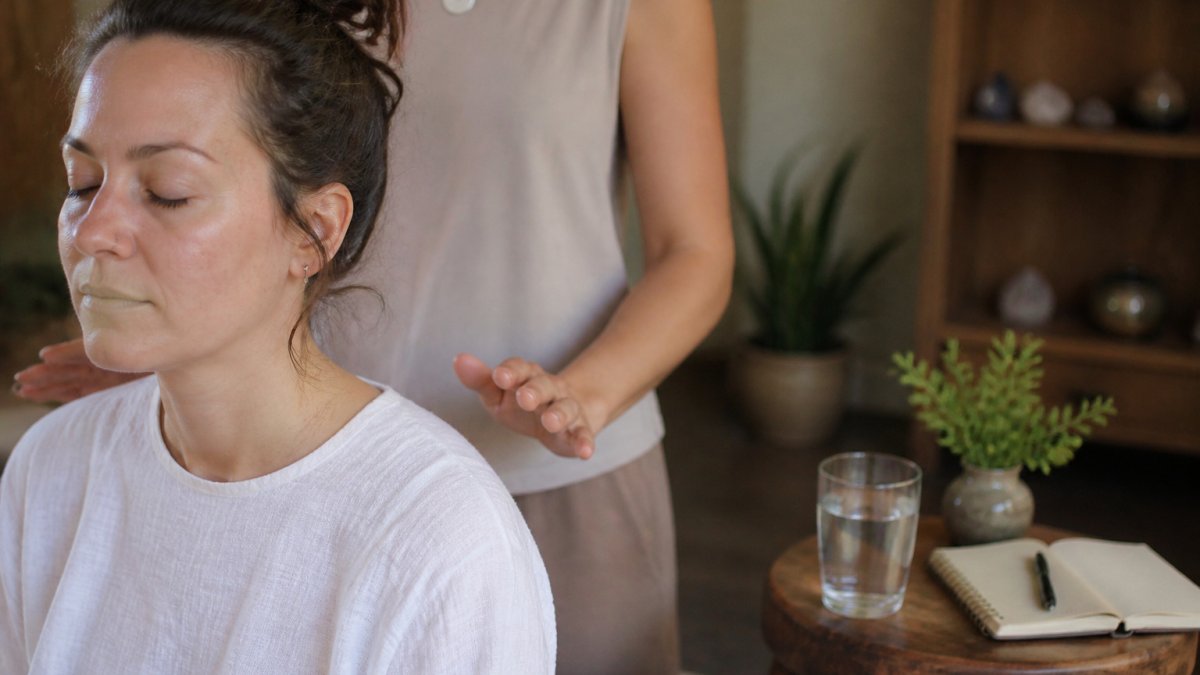
A typical Reiki session is quiet and unhurried. You can see how a Reiki and energy healing massage session is structured before booking. You stay fully clothed and lie on a massage table while the practitioner places their hands lightly on or just above different parts of your body.
Here's what to expect:
- A short talk about your pain and goals
- Lying still while the practitioner works through the body
- Possible warmth, tingling, or deep relaxation
- A few minutes to rest and breathe before you get up
Nothing about the session should hurt. If it does, say so right away.
What the Energy Healing and Pain Research Actually Shows
This is where it pays to slow down. The research on energy healing for chronic pain is real, but it's also limited in ways that matter. Many of these studies are small and lack strong controls, blinding, or long follow-up. For a closer, research-focused look at whether energy work has scientific support, read the full review. That doesn't make them worthless. It means you have to read them carefully.
Here's what the evidence can and can't tell you:
- It can show whether people felt better. Pain, stress, and relaxation are subjective. Studies can measure changes in how people rate their pain or mood.
- It can't prove a specific energy mechanism. No well-designed study has demonstrated a measurable life force or energy field that practitioners manipulate. Improvements may come from touch, attention, expectation, relaxation, or the simple act of lying still for an hour.
- It can't settle long-term effects. Most trials follow people for weeks, not months or years. We don't have good data on whether benefits last.
A few patterns show up across the literature:
- Some trials report short-term reductions in pain intensity or stress scores after Reiki or healing touch.
- Others find results similar to placebo or sham treatments.
- Reviews consistently call for larger, better-controlled studies.
One more thing worth knowing: outcomes likely differ by condition. Someone with fibromyalgia may respond differently than someone with arthritis or nerve pain. The research rarely breaks results down that way, so keep your own experience, and your doctor's input, in the picture.
How Massage for Chronic Pain Compares With Energy Work
Massage is one of the more studied hands-on approaches for muscle tension and pain. To see what a deep tissue massage for tension and mobility involves, check the service details. Deep tissue massage, for example, focuses on tight muscles and restricted movement, and many people find it helps with stiffness.
The key difference:
- Massage works on the physical tissues you can feel
- Energy work works on the body's energy, with lighter or no direct pressure
If your pain comes from muscle tightness, massage may be a more direct option. Some people combine both. Ask your practitioner how they'd approach your specific situation.
Energy Work Safety: When to Keep Medical Care in the Picture
Energy work is generally low risk, but it should never replace medical care. Keep seeing your doctor, especially if you:
- Have pain that is getting worse or spreading
- Notice numbness, weakness, or loss of bladder or bowel control
- Have a new injury or a fever along with your pain
- Take medications that need regular monitoring
Tell any energy practitioner about your diagnoses and medications. Stop and call your doctor if you feel worse after a session. Seek urgent care for sudden or severe symptoms.
How to Try Energy Work and Track Whether It Helps
Trying energy work is simple if you keep it structured. The goal isn't to prove anything, it's to gather honest information about whether it helps you.
Before you book:
- Set one clear goal. Pick a single thing to watch, like sleep quality, how far you can walk, or how often you take pain medication. Vague goals produce vague answers.
- Ask about training. Training requirements vary by state and modality. Ask where they trained, how long they've practiced, and whether they've worked with your condition.
- Be upfront about your pain history. Tell them your diagnoses, medications, and any areas to avoid.
During your trial:
- Rate your pain before each session on a 0 to 10 scale. Same time of day, same scale.
- Book two or three sessions spaced a week or two apart. One session rarely tells you much.
- Note how you feel the next day, pain level, energy, mood, and sleep. The next-day picture often matters more than the immediate afterglow.
What to track:
- Pain intensity (0-10) at a consistent time
- Sleep quality (hours and how rested you feel)
- Mobility (can you do a specific task, stairs, a short walk, getting out of a chair?)
- Flare-ups (how many, how severe)
- Medication use (doses per week)
- Daily activities (what you could do that you couldn't before)
A simple notebook or phone note works fine. After a few weeks, look for patterns, not single good or bad days. If your numbers don't change after several sessions, that's useful information too, and worth telling your doctor.
Booking Your First Session at Body Alchemy Sedona
If you'd like to try energy work with a therapist-led team, Body Alchemy Sedona offers energy work, massage therapy, sound healing, and breathwork, with both in-studio and mobile appointments.
Be upfront about your pain history when you book so the session can be tailored to you. For current availability and details, contact Body Alchemy Sedona directly. You can book online or call/text to schedule your first session. Dive in with us when you're ready.
Frequently Asked Questions
Can Reiki help relieve chronic pain?
Some people report that Reiki helps them relax and feel less tense, and that can make pain easier to live with. The research is still limited and mixed, so it is not a proven pain treatment on its own. Think of it as a complementary option you can try alongside your existing care. Track how you feel over several sessions in a simple daily log, noting pain level, sleep and how well you get through normal tasks, so you have a clearer picture than a single good or bad day gives you.
Is energy work safe to use alongside medical treatment?
In most cases, energy work is low risk because it does not involve pressure, manipulation or medication. Still, it should not replace diagnosis or treatment for pain. Tell your doctor or physical therapist that you are trying it, and keep taking prescribed medications as directed. Seek medical care promptly if your pain suddenly worsens, spreads, comes with weakness or numbness, or is linked to an injury, fever or other new symptoms.
Can massage help with chronic pain?
Massage is one of the more studied hands-on approaches for chronic pain, and many people find it eases muscle tension and helps them move more comfortably. Results vary by condition and by person. Massage and energy work can be combined, but they work differently: massage addresses soft tissue directly, while energy work focuses on relaxation and attention. Ask any practitioner what training they have for your specific pain before booking.
How should I choose an energy-work practitioner for chronic pain?
Look for a practitioner who asks detailed questions about your pain, medications and medical history before starting, and who will tell you plainly what energy work can and cannot do. Ask about their training and whether they work alongside medical providers. Avoid anyone who promises a cure, discourages you from seeing a doctor, or asks you to stop prescribed treatment. A good first session should leave you clear on what to expect and what to track.